
WHOIS Privacy: What It Hides and When It Is Worth $10
What WHOIS privacy really hides, where your data still leaks (DNS, hosting, certificates) and when the $10 per domain option at checkout is worth it.
"WHOIS privacy" is one of the most common words in domain registration and one of the least understood. It is genuinely useful: without it, your name, address, phone and email can sit in a public database for as long as you own the domain. At Riki Domains it is a paid option, $10 per domain in the cart. This guide explains what the public record contains today, what a privacy service actually does, where data still leaks even with privacy on, and when the $10 is worth it.
What the public domain record shows today
Every registered domain has a contact record maintained by the registry. For decades it was served over the WHOIS protocol; in 2025 the old protocol was retired in favour of RDAP, but the data model stayed the same: registrant, administrative and technical contacts, each with a name, organisation, postal address, phone and email, plus the registrar, nameservers and important dates.
Since 2018, registrars serving EU residents redact personal fields because of GDPR, and many registrars redact for everyone. But "redacted" is not the same as "private": the organisation field often stays visible, redaction policies differ between registrars and zones, and the registrar still holds your real data and may disclose it on request. A dedicated privacy service is the only thing that replaces your data with somebody else's in the record itself.
What WHOIS privacy actually does
A WHOIS privacy service (also called a proxy service) puts its own contact details into the public record instead of yours. The domain remains yours: you control the DNS, renewals and transfers, and the registrar knows who the real owner is. From the outside, anyone who looks up the domain sees the privacy service's name, address and a forwarding email address.
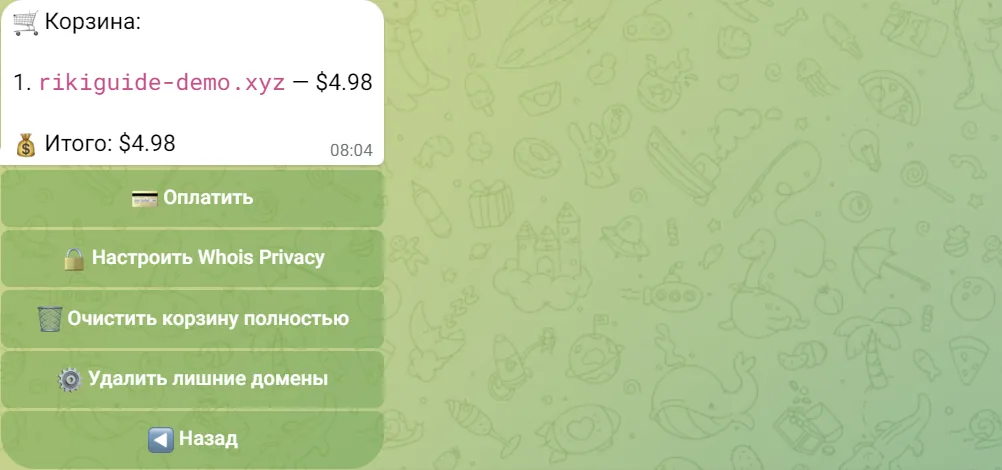
At Riki Domains the option is added in the cart, per domain, before payment. Deciding at checkout matters more than it seems: historical WHOIS archives store every version of a record, and a domain that was public for even a week stays discoverable for years.
When the $10 is worth it, and when it is not
Worth it:
- Personal projects where you do not want your name next to the site.
- Anything in a competitive niche, where competitors look up owners first.
- Portfolios of several domains: one public record links all of them to one person.
- Anything you may sell later: a clean history is part of the price.
Not worth it:
- Company sites that must show the legal entity anyway, for example because of local law or payment providers.
- Platinum and Titan zones (.at, .to, .com.co, .co.com, .ac and others): the bot marks the option "unavailable" because it is not needed there. These domains are registered manually by the service's staff, and the registry record holds Riki Domains' details, not yours. Privacy is built into the procedure itself, so there is nothing to pay for. Titan domains must run on the client's own nameservers, usually Cloudflare, so they share no DNS servers with other clients.
- Throwaway domains for a few weeks, if nothing links them to you besides the record.
Where your data still leaks
Privacy on the record protects exactly one thing: the contact fields. Here is where the same person is exposed anyway, in order of how often it happens.
1. DNS records
An A record points straight at your server IP. The nameservers reveal your DNS provider, and the MX records reveal your email provider. Anyone can read these in a second. The fix is to proxy the website through Cloudflare, so the public IP belongs to Cloudflare and not to your hosting.
2. Hosting neighbours and reverse DNS
If the server hosts several of your projects, reverse IP lookups list them side by side. Reverse DNS entries sometimes contain the owner's hostname or company name. Separate projects should live on separate IPs or behind a proxy.
3. TLS certificates
Every TLS certificate is published in Certificate Transparency logs, which are public and searchable. A certificate that covers shop.example.com, admin.example.com and john-laptop.example.com publishes all three names forever. Use one certificate per public hostname, or a wildcard, and never include internal names.
4. Shared tracking identifiers
A Google Analytics, Google Ads or AdSense identifier reused on two sites links them publicly through third-party databases. The same goes for identical favicons, copied contact details, reused social links and shared payment buttons.
5. Historical archives
Archived copies of WHOIS records, old DNS data and cached pages survive long after you change something. A domain registered without privacy, or a site that once exposed its IP, keeps that history.
6. Payment data
A card payment at the registrar ties the domain to a legal name and a bank even when the public record is private. A crypto payment does not create that link. The same applies to every renewal, not only to the first purchase.
Register a domain in 2 minutes
1,500+ zones, WHOIS privacy on request, crypto payment and DNS management — all inside the Telegram bot.
A private domain setup, step by step
The order matters: do these before the site goes live, not after.
- Add privacy in the cart so no public version of your data ever exists. At Riki Domains it is $10 per domain at checkout.
- Pay with crypto so the purchase is not tied to a card. Keep paying renewals the same way.
- Use a dedicated contact channel: a separate Telegram account or email for the project.
- Proxy the site through Cloudflare before you publish anything, so the first DNS snapshot already shows Cloudflare's IP.
- Issue certificates carefully: one public hostname per certificate or a wildcard, no internal names.
- Do not share identifiers across projects: analytics, ads, favicons, phone numbers, wallets shown on the site.
- Check yourself once a quarter: look up your domain's RDAP record, DNS and certificate history the way a stranger would.
How registration works at Riki Domains
Registration happens in the Telegram bot @riki_domains_bot or in the web panel. You search a name across 1,500+ zones, pick a plan, add WHOIS privacy to the standard-zone domains that need it, pay, and the domain activates automatically; Platinum and Titan domains are registered by the staff with the service's details in the record. The DNS manager supports A, AAAA, CNAME, MX, TXT and NS records; Cloudflare can be connected from the dashboard; renewals can be automated. Plans differ by stability and price model: Standard from $3 with prices depending on the zone, Platinum ($30 to $70) with fixed prices in verified zones, and Titan ($90 to $200) as a permanent domain for critical projects. The purchase itself is shown step by step in How to buy a domain in the Riki bot.
Privacy is not a feature you buy once and forget. It is a set of habits around the domain, and the $10 option at checkout is simply the first and cheapest of them.
FAQ
How much does WHOIS privacy cost at Riki Domains?
It is an option in the cart, $10 per domain, chosen before payment, for the standard zones of the Standard plan. In the Platinum and Titan zones the option is marked as unavailable because it is not needed: those domains are registered manually by the service's staff with Riki Domains' details in the registry record, so your data never goes there.
Does WHOIS privacy make the domain anonymous?
It hides your contact data from the public record. Full anonymity also needs a hidden hosting IP, a separate contact channel, a crypto payment and clean certificates. The checklist in this guide covers all of it.
Will the domain work normally with privacy enabled?
Yes. Privacy only changes what the public record shows. DNS, email, transfers and renewals work exactly as before.
What happens to legal notices sent to the privacy contacts?
The privacy service receives them and forwards what is relevant to you through your account, so you never miss an important message while your own contacts stay hidden.
Can I add privacy later, after the domain is registered?
The option is chosen in the cart at purchase. If a domain was registered without it, historical WHOIS archives may already hold the public record, so it is cheaper to decide at checkout.
Register a domain in 2 minutes
1,500+ zones, WHOIS privacy on request, crypto payment and DNS management — all inside the Telegram bot.