
Phishing and Scam Site Takedown Service: How It Works
How Riki Domains gets phishing and scam domains suspended through complaints to registrars and hosts: formats, prices, timelines and what the client provides.
Scam victims and brands targeted by phishing hit the same wall: registrars and hosting providers respond slowly, want evidence in their own format and often reply with a template. Riki Domains takes that work over: it prepares the complaints, files them everywhere the site has a point of failure and follows through until the domain is suspended. Below is how the service works, what it costs and what to expect.
Who needs it
- Victims of prepayment schemes. A typical case from practice: sites that "sell" cars and heavy machinery from the US to an English-speaking audience on prepayment, collect the money and vanish. There are dozens of such storefronts and they clone faster than anyone can report them by hand.
- Crypto projects and their users. Phishing copies of wallets, exchanges and dApp interfaces that steal seed phrases and transaction signatures.
- Brands and services. Fake login pages, "support desks" and "promotions" under someone else's name.
- Lawyers and agencies who handle such cases for clients and want to outsource the technical part.
How it works
A domain rests on several supports: the registrar, the zone registry, the hosting provider, a CDN, the mail provider, sometimes a payment gateway. Each has acceptable-use rules and a complaint channel. A takedown is achieved by filing an evidence-backed complaint at every point where the violation is obvious and pushing each one to a decision, rather than sending a single message into a contact form.
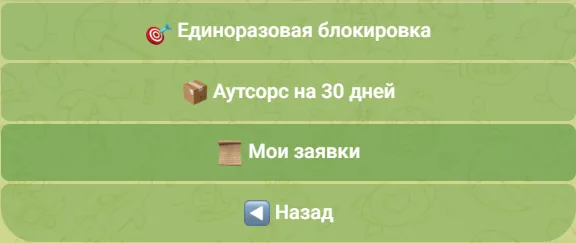
- Request. In the @riki_domains_bot bot, open the "Block a competitor" section and choose the format: a one-off takedown or 30-day outsourcing. That is how the section is labelled in the current bot; it is about fraudulent and phishing sites.
- Input. You provide the addresses and everything that leads to the violating content: links to specific pages, screenshots, correspondence with the scammers, payment examples. This is mandatory: without evidence a registrar does not review a complaint.
- Work. Complaints are prepared and filed manually with the registrar, the zone registry and the host, and under outsourcing also against the server infrastructure. Each thread is followed up until a decision.
- Result. A request is complete when the domain receives the clientHold or serverHold status: it stops resolving and the site no longer opens. Under outsourcing a report arrives for every domain and server.
Formats and prices
| One-off takedown | 30-day outsourcing | |
|---|---|---|
| For | one domain or a few separate ones | a stream of domains, clones that keep appearing |
| Price | $50 per domain | $1,000 per 30 days |
| Volume | per domain | up to 100 domains, more by agreement |
| Deadline | 14 working days per domain | a month of work |
| Included | complaints to the registrar, registry and host until a result | the same plus complaints against server infrastructure and a report per domain and server |
| If it fails | the amount returns to your balance | — |
The one-off terms are fair in both directions: $50 is reserved on the balance, and if the domain is not suspended within the deadline the money comes back.
Register a domain in 2 minutes
1,500+ zones, WHOIS privacy on request, crypto payment and DNS management — all inside the Telegram bot.
What speeds up a takedown
Registrars and hosts respond to evidence, not emotion. The more precise the package, the shorter the correspondence.
- Direct links to the violating pages, not the home page.
- Screenshots with the date and the address bar. For phishing: the data entry form and the address it imitates.
- Money trail. The payment details you were asked to use, chats with the "manager", transfer confirmations.
- The link to the brand or the victim. If your site is being copied, show the original and its publication date.
- The list of clones. Schemes live on dozens of domains; if the neighbours are known, they are taken down in one series.
What the service does not do
- It does not take down domains registered through Riki Domains.
- It does not work on sites without a policy violation: content disputes, competition, personal conflicts. The basis of a complaint is always specific: phishing, fraud, a breach of the platform's policies.
- It does not use technical attacks. The only tool is complaints filed in the established order with evidence.
How to order
Open the bot, go to the "Block a competitor" section, pick the format and send the addresses in one message: one per line, separated by spaces or commas, in any form including full links and IDN. For outsourcing and volumes above 100 domains write to @riki_domains_support: terms are agreed individually. Request status is visible under "My requests".
FAQ
Which sites do you take down?
Phishing pages, scam schemes and other resources that violate registrar and hosting policies: fake bank and service logins, goods sold on prepayment and never delivered, crypto theft through fake forms. Domains registered through Riki Domains are out of scope.
How much does one domain cost?
A one-off takedown is $50 per domain. The amount is reserved on your balance for the duration of the work: if the domain is suspended within the deadline it is charged, otherwise it is returned to the balance.
How long does it take?
The deadline for a one-off request is 14 working days. In practice it depends on the registrar and host: some react within a day, others take weeks, which is why complaints go to several addresses at once.
What do clientHold and serverHold mean?
They are domain statuses at the registrar and the registry under which the domain stops resolving, so the site on it no longer opens. That outcome counts as a completed request.
What do you need from me?
The site addresses and the details that lead to the violating content: links to specific pages, screenshots, correspondence, examples of the fraud. The more complete the evidence, the faster registrars respond.
Register a domain in 2 minutes
1,500+ zones, WHOIS privacy on request, crypto payment and DNS management — all inside the Telegram bot.